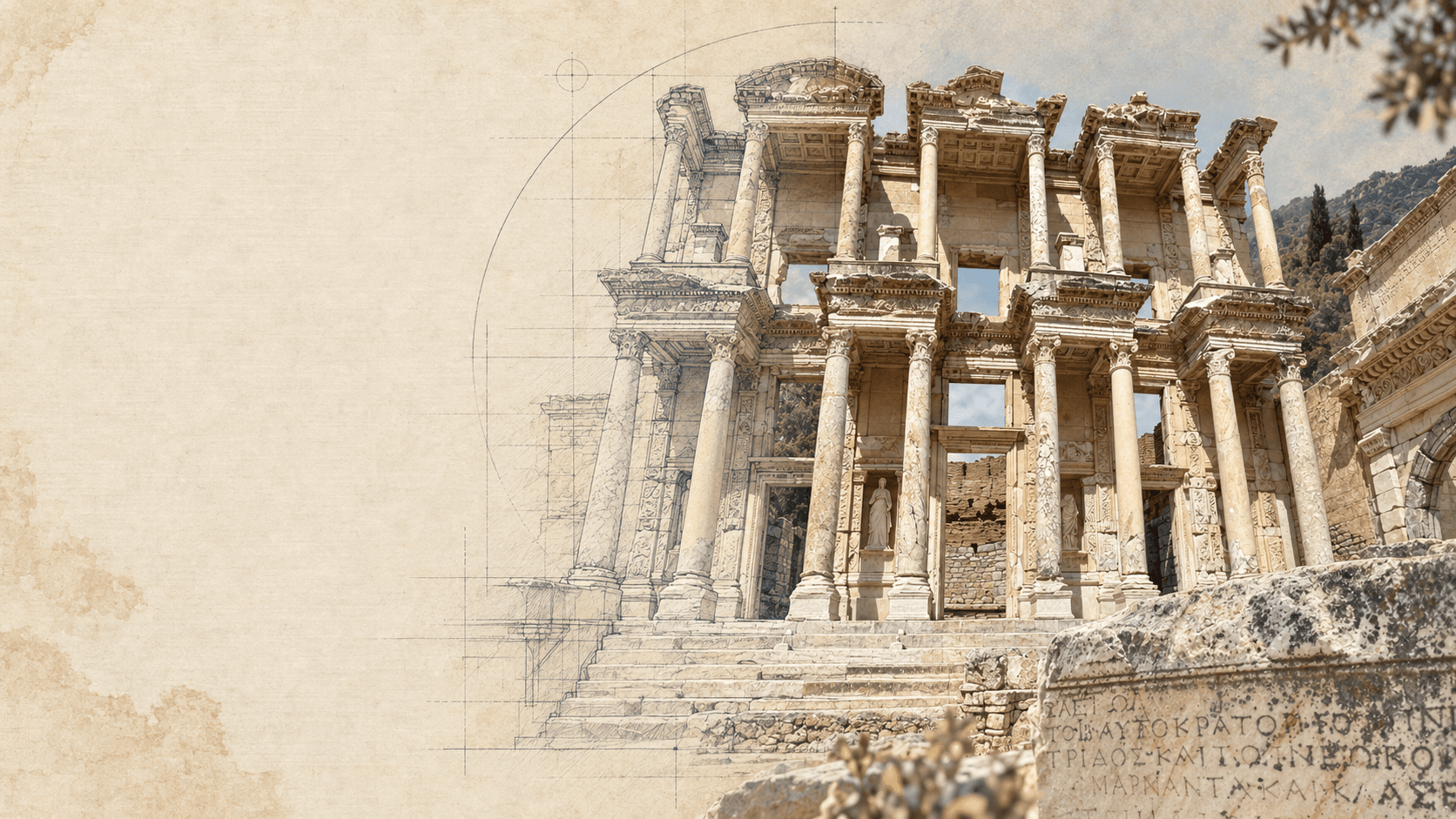
The seven churches as a missiological map
First century, in the letters of Revelation, read with later archaeology


Theme 1 of 6
Material culture — graffiti, inscriptions, temples, and artifacts — as missiological evidence. Reading the stones to reconstruct ancient cultic forms and adjudicate contemporary mission strategy.
What does Michael T. Cooper mean by missiological archaeology, and why do the stones matter for mission now?
At its core, I will propose that the relationship between missiology and archaeology serves to unveil God's movement in the material context in which Christianity emerged
Material culture — graffiti, inscriptions, temples, and artifacts — as missiological evidence. Reading the stones to reconstruct ancient cultic forms and adjudicate contemporary mission strategy.
The argument runs in one direction. The stones and spaces of Asia Minor show a church that adapted form and stayed recognizable. Archaeological exegesis is the discipline of learning a people well enough to see that. Application refuses neutral architecture. Missiological parallelism, shared with Amberg, names the declaration that has to accompany the adaptation: Jesus is superior to the saviors, healers, rulers, and philosophies the stones already advertise. Without the last move, reuse of space is only a building program. Without the first, application invents a first-century church the ground does not show.
Acts 19:8-10
The hall where daily reasoning happened
Cooper reads the synagogue months and the hall of Tyrannus as one missiological sequence. Dialegomai is his key word, glossed as argumentative discourse of the sort philosophical schools practiced. The withdrawal from the synagogue is not, in his telling, a retreat from public argument. It is a change of room. The disciples go with him. The reasoning continues daily. His timeline in the introducing chapter places the school in AD 52 and the two years of teaching there before the riot associated with Artemis. He does not reprint a long strategy from the verse. He uses it to show that Paul took a familiar educational form. In the grounding chapter he adds that the theology which emerged was faithful to the story of Jesus and relevant for Asia, and he calls that a beautiful example of missiological theology. The residents-of-Asia line in verse 10 is, for him, a claim about a movement's reach, which he handles again when he writes on movements. Here it is the outcome of a particular room and a particular kind of speech.
Acts 19 gives the room. Colossians 1 gives a letter read against statues and earthquakes. Acts 17 gives the method on an inscription and a city's poets. Together they are Cooper's case that mission in the New Testament was exegetical. The material world was part of the argument, and the declaration of Christ stayed intact inside that attention.
Historical Context
Cooper's historical argument for this theme is the material record of Asia Minor, dated where his sources date it. He is explicit that he is not rewriting Ramsay or Hemer on the seven churches. He wants the missiological practices those cities make visible. Figures below are his or his sources', as the chapters state them.
First century, in the letters of Revelation, read with later archaeology
Fourth through sixth centuries, on Bayliss's dating
AD 52, two years of school teaching, on Cooper's timeline
The shared definition of missiological parallelism belongs to A.K. Amberg and Michael T. Cooper. The narrative above uses Cooper's own sentences around that definition. Figure numbers in the Bayliss chapter (7.4 through 7.10) are named in the file. The photographs are not reproduced here. He points readers to a study guide at Ephesiology Master Classes, with the code "anewmovement," for pictures. That pointer is his. It is not a scored tool.
Cooper reports three patterns of turning pagan religious space into churches, and he lingers on Sardis, where a small church stood inside the Artemis temenos.
Asia Minor temples, fourth to sixth centuries, as Bayliss dates the reuse
After three months in the synagogue, Paul took the disciples to the hall of Tyrannus and reasoned there daily, in the idiom of a philosophical school.
Ephesus, the school of Tyrannus, which Cooper's timeline places in AD 52
Cooper locates Theophilos among the elite of Ephesos and uses him as the example of a gospel told in parallel to a lived religious world.
Ephesos, civic and religious elite, first century
Spend one week on a single public place using Cooper's three techniques.
Take two people through your meeting space and ask what the room claims.
Name one cultural form you already use and test it as a missiological parallelism.
Curated Resources
book
27-from-archaeological-to-missiological-application
book
40-depth-of-evangelistic-engagement
article
article
Watch for the Distortion
A team treats an archaeological detail, a house, a hall, a table, as the required model for every new church. Training slides present the find as a universal strategy. Context drops out, and the first century becomes a franchise.
A team treats an archaeological detail, a house, a hall, a table, as the required model for every new church. Training slides present the find as a universal strategy. Context drops out, and the first century becomes a franchise. Cooper says the record will not bear that use. Evangelistic strategies in the early church differed from today's and were suited to a different context. He also says it is inappropriate to build a strategy from the archaeological observations as if current methods and ancient ones were the same. The stones check anachronism in church-planting movements, disciple-making movements, and traditional planting. They do not hand over a template.
Mission training uses later colonial compounds, foreign floor plans, and imported ritual objects as if they showed how the first Christian centuries built churches. The local material culture is treated as a problem to replace. Cooper sets colonial mission archaeology beside the first centuries and says they diverge. He quotes Elizabeth Graham: the overwhelming impression from mission archaeology is that Christianity is both monolithic and genetically European. First-century Christianity, on his reading, had no identifiable architectural type for the ekklēsia. Space was adapted. He wants that contrast in view so contemporary work is less likely to repeat the colonial pattern.
Any local form is baptized because it feels indigenous. Distortion inside the form is left unnamed. The church congratulates itself for contextualization and never says why Jesus is different from the savior the form already offers. The parallelism chapter requires two outcomes at once: clarification of what God is doing, and confrontation of spiritual distortion. Cooper's application chapter adds that form is never neutral. The path-forward sentence he writes is that uncritical affirmation of culture risks syncretism, just as ignoring cultural forms risks irrelevance. Bayliss, as Cooper quotes him, even reads some temple graffiti as exorcism rather than as a friendly merger.
Key Terminology
In Gods, Emperors, Philosophers, Cooper calls archaeological exegesis the task of digging into Asia Minor's excavations until spiritual and cultural dynamics show up with the ruins. Graffiti, spolia, architecture, and artifacts are the texts. In Ephesiology the sister phrase, missiological exegesis, is the missionary's work of understanding a people's peculiarities in order to see God's work there, by dialogue, observation, and historical study. The two phrases meet when a building or an inscription is the cultural fact under study.
Cooper says he and A.K. Amberg coined the phrase beyond Colin Hemer's polemical parallelism. Their definition calls it a literary, rhetorical, and missiological device. A cultural or religious form mirrors a biblical narrative, image, or idea. It clarifies what God is doing and confronts spiritual distortion. Cooper's own gloss says the method reveals God's presence in culture and Christ's sufficiency, and that it engages people respectfully rather than dismissively. In Asia Minor the content is Jesus as logos, healer, pantokratoros, and God.
In Launching a Movement I he writes that connecting history to a present situation gives the nations a sense of what he has called ancientization, citing his own 2009 work. It is the ability to relate past and present so the present shares an identity with the past and the two histories become one story that legitimizes the present inside God's mission. He says Paul saw continuity with God's work in the world rather than a historical break that would isolate the church from culture. The same word appears in the front matter of Letters to Churches, where he likens the recovery of early Christian voices to a postmodern paleo-orthodoxy in Thomas Oden's sense.
Cooper glosses ekklēsia as the gathering and uses it because English "church" already suggests a place. In the archaeology book he stresses that early Christianity had no identifiable architectural type for this gathering. Space was adapted, often in places of peace and in homes of wealthier saints. He says that adaptive pattern is not a norm to copy mechanically. It is evidence that the gathering can inhabit more than one kind of room. The application chapter then asks what any particular room communicates.
In the Bayliss chapter the temple-spolia-church is the third type of reuse. Columns, capitals, and marble leave a temple and enter a church elsewhere. At Ephesos, marble from the Artemision was carried uphill to the Church of St. John. Some columns bear inscriptions naming who repurposed them or who paid. A capital marked with a cross remains at the Artemision as a witness. Cooper does not treat every reused stone as a sermon, and he notes that spolia also went into houses and public buildings. When the destination is a church, he reads the carrying of the stone as proclamation.
Launching a Movement I introduces the phrase through Justin, whom Cooper pictures learning God's story from an Ephesian believer. Whatever philosophers taught well belongs to Christians. Heraclitus, Plato, and Aristotle can be called, in Justin's wake, Christians before Christ, because the seed was divinely instilled in noble thoughts. Cooper sets this against Tertullian's break between Athens and Jerusalem and against Cyprian's tightening of salvation to the institutional church. In the 2026 book, missiological parallelism is rooted in this insight and then re-centered on the fullness revealed in Jesus.
Dr. Michael T. Cooper is an American evangelical missiologist, author, and professor best known for coining and developing "Ephesiology" — the study of the first-century church-planting movement centered in Ephesus. He serves as Missiologist in Residence at East-West and affiliate faculty at Kairos University.
The parallelism that keeps archaeology from syncretism is the cultural argument of the same Asia Minor book, carried into the present in When Evangelicals Sneeze.