

Theophilos, Tyrannos, Trophimus, and Paul’s Ephesian Circle
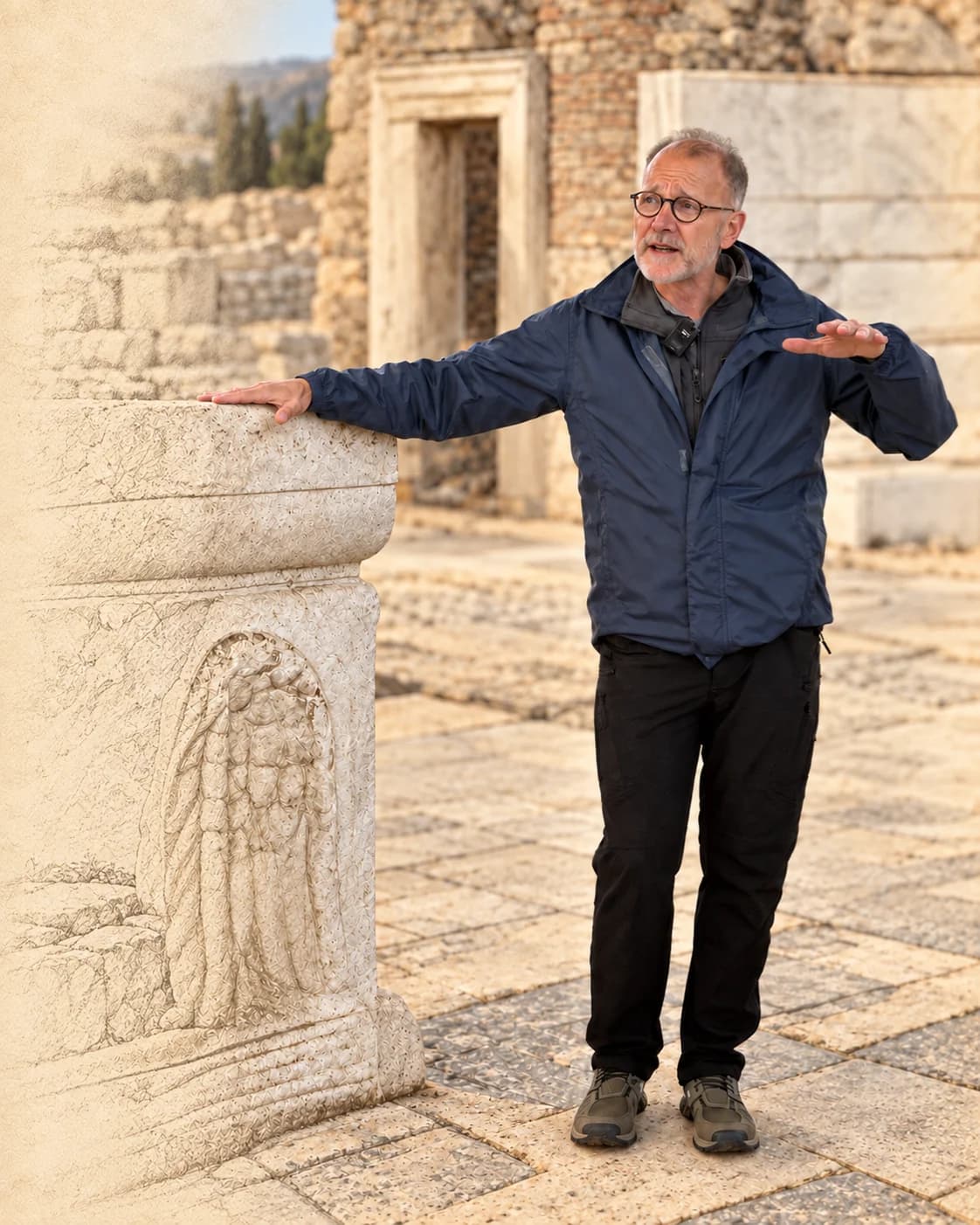
Hundreds, if not thousands, of people walk by the prytaneion each day with little appreciation for its significance in the city of Ephesos, much less for its importance to first-century Christianity. Serving not only as the religious and civic center of the prestigious city, the prytaneion is renowned for its archive preserving the names of some of Ephesos’s most prominent citizens. These ancient columns and marble revetment panels tell the stories of families, friends, and colleagues who served the city as administrators, priests, benefactors, and guardians of Artemis. Among the names listed during the reign of Claudius are three names that also factor prominently in Luke’s account of Paul’s three years in Ephesos: Theophilos, Tyrannos, and Trophimus.
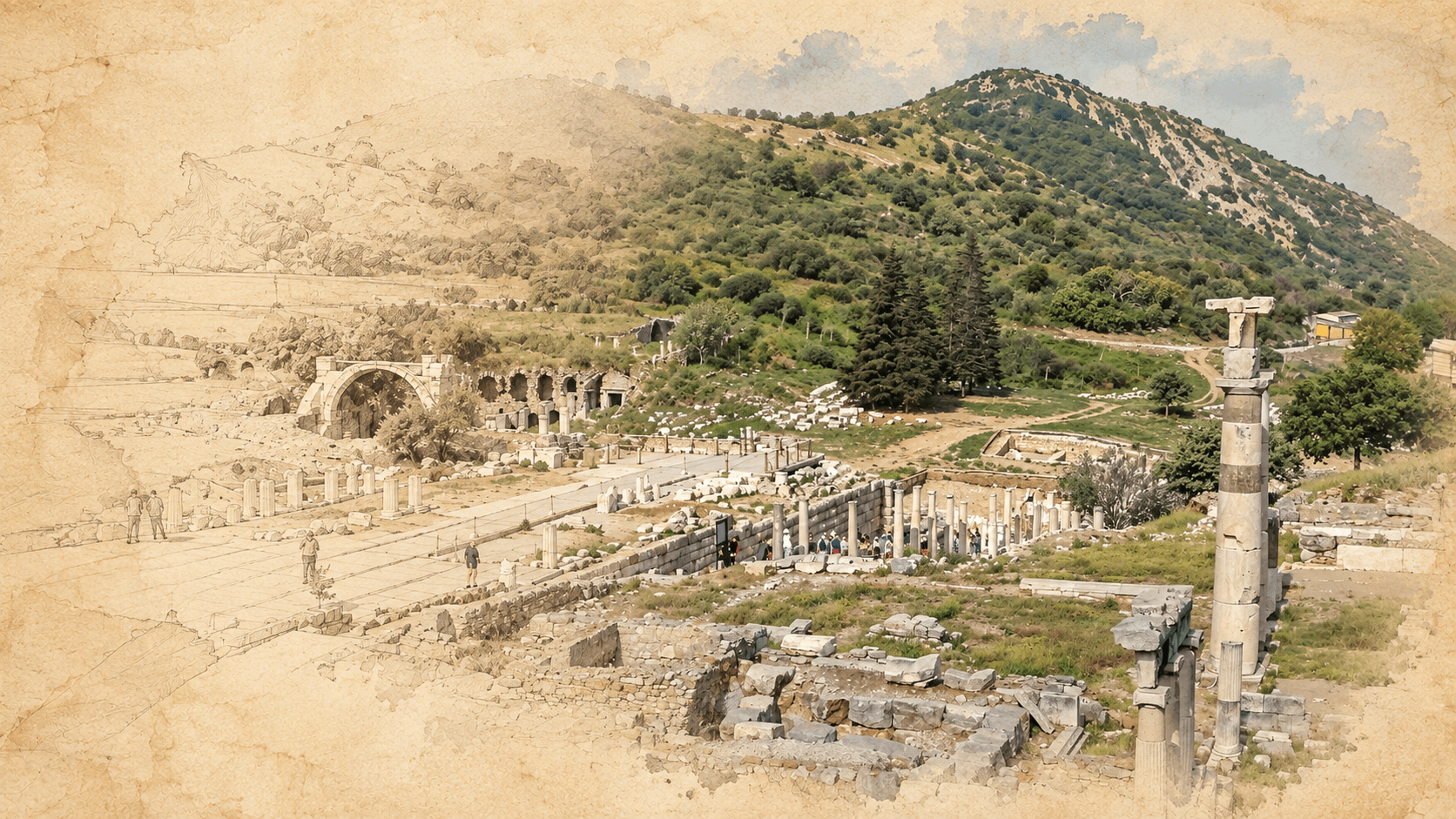
I first began paying close attention to the prytaneion because of a question that seemed, at first, too speculative to pursue: What if Luke’s “most excellent Theophilos” was not an abstract “lover of God,” nor merely an unknown patron somewhere in the Roman world, but a real Ephesian civic-religious leader whose name is preserved in stone? The more I walked the site, photographed the inscriptions, and traced the civic geography of Ephesos, the more difficult it became to ignore the convergence. Ephesos was not merely a backdrop to Paul’s ministry. It was a city of sacred power, civic memory, religious identity, and public allegiance. If Luke’s Theophilos belonged there, then Luke-Acts becomes not only a literary and theological work, but also a carefully framed account addressed to someone embedded in the very structures Paul’s message confronted.
The prytaneion stands in the upper civic quarter of Ephesos, near the bouleuterion and the state agora. It was the seat of the prytanis, the official responsible for civic and religious affairs, and it housed the sacred flame of Hestia, symbolizing the unity and continuity of the city. In Ephesos, civic identity and religious devotion were not separate realms. The city’s public life was ordered around Artemis, imperial loyalty, patronage, benefaction, and the ritual obligations of elite families. To have one’s name inscribed in the prytaneion archive was no minor honor. It located a person within the remembered leadership of the city.
That is what makes the appearance of Theophilos, Tyrannos, and Trophimus so striking. The claim is not that archaeology has “proven” the identity of Luke’s addressee, Paul’s lecture-hall host, or Paul’s Ephesian companion. Archaeology rarely speaks in that manner. Rather, the prytaneion gives us something both more modest and more interesting: a historically plausible social setting in which Luke’s narrative and the Ephesian archaeological record intersect.
Luke addresses both his Gospel and Acts to Theophilos. In the Gospel, he calls him “most excellent” (kratistos), a form of address Luke elsewhere uses for high-status officials such as Felix and Festus. The title suggests that Theophilos was not an ordinary reader. He was likely a person of standing, perhaps a patron, perhaps a civic official, perhaps a religiously significant figure who needed “certainty” concerning the things he had been taught. Scholars have long debated his identity, but the Ephesian evidence deserves attention. The name Theophilos appears in inscriptions connected with the prytaneion, including names associated with the Kouretes and other civic-religious functions. One especially intriguing figure is Theophilos son of Meandros, dated to the first half of the first century, who appears in connection with the Kouretes, the young men who served in the rituals of Artemis.
The Kouretes matter because they were not generic functionaries. In Ephesian tradition, they were bound to the nativity mythology of Artemis. Each year, they participated in rituals associated with the birth of Artemis and Apollo, clashing weapons to conceal Leto’s labor from Hera. By the first century, this myth had become thoroughly localized in Ephesian sacred geography, with Ortygia and Mount Solmissos woven into the city’s religious imagination. If Luke’s Theophilos had served among such figures, then Luke’s unique emphasis on the birth of Jesus becomes even more suggestive. Luke’s infancy narrative is not merely charming prelude. It is a theological and missiological declaration. Artemis’s birth was hidden in mythic secrecy; Jesus’s birth is announced openly by heavenly beings. Artemis is guarded by Kouretes; Jesus is proclaimed by angels. Artemis’s story served the civic identity of Ephesos; Luke’s story announces a kingdom that relativizes every civic and cultic claim. Artemis is declare the savior of Ephesus; Jesus is the savior of the kosmos.
This does not mean Luke copied Artemis traditions or that every detail should be forced into a one-to-one parallel. It does suggest that Luke’s narrative would have resonated powerfully with an Ephesian elite familiar with hymns, processions, divine births, sacred geography, and the claims of Artemis as savior and guardian. Luke’s Gospel begins with certainty, but that certainty is not abstract. It concerns the identity, authority, and mission of Jesus in a world already crowded with divine claims.
The second name, Tyrannos, draws us directly into Acts 19. After Paul’s initial work in the synagogue, Luke tells us that Paul withdrew the disciples and reasoned daily in the hall, or school, of Tyrannos. As a result, “all the residents of Asia heard the word of the Lord, both Jews and Greeks” (Acts 19:10). For those of us interested in movement dynamics, this is one of the most important sentences in Acts. Paul’s ministry in Ephesos became a catalytic center for the spread of the name of Jesus throughout the province of Asia.
Yet the “hall of Tyrannos” has often remained an abstraction. Who was Tyrannos? What sort of space did he possess or oversee? Was this a private lecture hall, a philosophical school, a rented public venue, or a space connected with Ephesian elite culture? The prytaneion inscription archive does not settle the question, but it does complicate it in productive ways. A Tyrannos appears among officials connected with the cult of Artemis, listed among the Kouretes. Another inscription in the Ephesian inscription gallery names a P. Cl. Tyrannos, though that later figure belongs to the second century and should not be identified with Paul’s Tyrannos. Still, the evidence confirms that the name Tyrannos was at home within the civic-religious world of Ephesos.
This matters because teaching in Ephesos was not peripheral to public life. It was embedded in the city’s networks of status, patronage, rhetoric, and religion. Nearby spaces, such as the so-called Hall of Gaius, suggest how elite halls could function for dining, instruction, entertainment, and religious association. Paul’s daily reasoning in the hall of Tyrannos should therefore not be imagined as a quiet Bible study tucked away from the city. It was more likely an act of public theological engagement in the shadow of Artemis, empire, and civic prestige. The name of Jesus spread within earshot of the institutions that claimed to define Ephesian identity.
The third name, Trophimus, brings the story from Ephesos to Jerusalem. Trophimus the Ephesian appears in Acts as one of Paul’s companions (Acts 20:4). Later, when Paul is seized in the Jerusalem temple, his opponents accuse him of bringing Trophimus, a Gentile from Ephesos, beyond the permitted boundary (Acts 21:29). The accusation is false, but its force depends on Trophimus’s identity. He was known as an Ephesian. He embodied the very mission Luke narrates: Gentiles from the cities of the empire being incorporated into the people of God through allegiance to Jesus.
The appearance of the name Trophimus in the prytaneion archive does not prove that the inscription refers to Paul’s companion. But it reminds us that Luke’s people are not literary props. They belonged to real cities, families, institutions, and networks. Trophimus was not simply “a Gentile.” He was an Ephesian Gentile, and that means he came from one of the most religiously charged urban environments in the Roman world. His presence with Paul in Jerusalem represents the long reach of the Ephesian mission.
Taken together, these three names invite us to reread Acts 19 with fresh eyes. Theophilos may have been the elite addressee for whom Luke narrates the certainty of Jesus and the innocence of the Christian movement. Tyrannos may represent the kind of civic-religious space in which Paul’s teaching became a provincial movement. Trophimus demonstrates the fruit of that movement: an Ephesian Gentile disciple whose identity in Christ brought him into the contested space of Jerusalem’s temple.
Again, caution is necessary. Archaeology does not allow us to declare that the Theophilos, Tyrannos, and Trophimus of the prytaneion are certainly the same individuals known from Luke-Acts. But certainty is not the only category of historical knowledge. What we have is convergence: chronological plausibility, geographic specificity, social coherence, and narrative significance. The names appear in the right city, in the right period, in the right kind of civic-religious context, and in relation to the very world Luke describes.
For me, that convergence has changed the way I walk through Ephesos. The prytaneion is no longer merely another ruin on the tourist path between the civic agora and the Curetes Street. It is a stone archive of memory. It preserves the names of those who served Artemis, guarded the city’s rituals, and embodied the prestige of Ephesian public life. Yet those same stones may also preserve the social world into which the name of Jesus spread with remarkable force.
Luke tells us that during Paul’s Ephesian ministry, the word of the Lord continued to increase and prevail mightily (Acts 19:20). That statement is missiological, but it is not disembodied. It happened in a city where Artemis was called great, where Rome claimed lordship, where civic officials guarded public order, and where names were carved into stone to preserve honor. The irony is profound. The monuments of Ephesos were built to remember the city’s elites. Yet today, their names may help us remember something else: how the earliest Christian movement engaged the civic, religious, and intellectual heart of one of the greatest cities of the ancient world.