

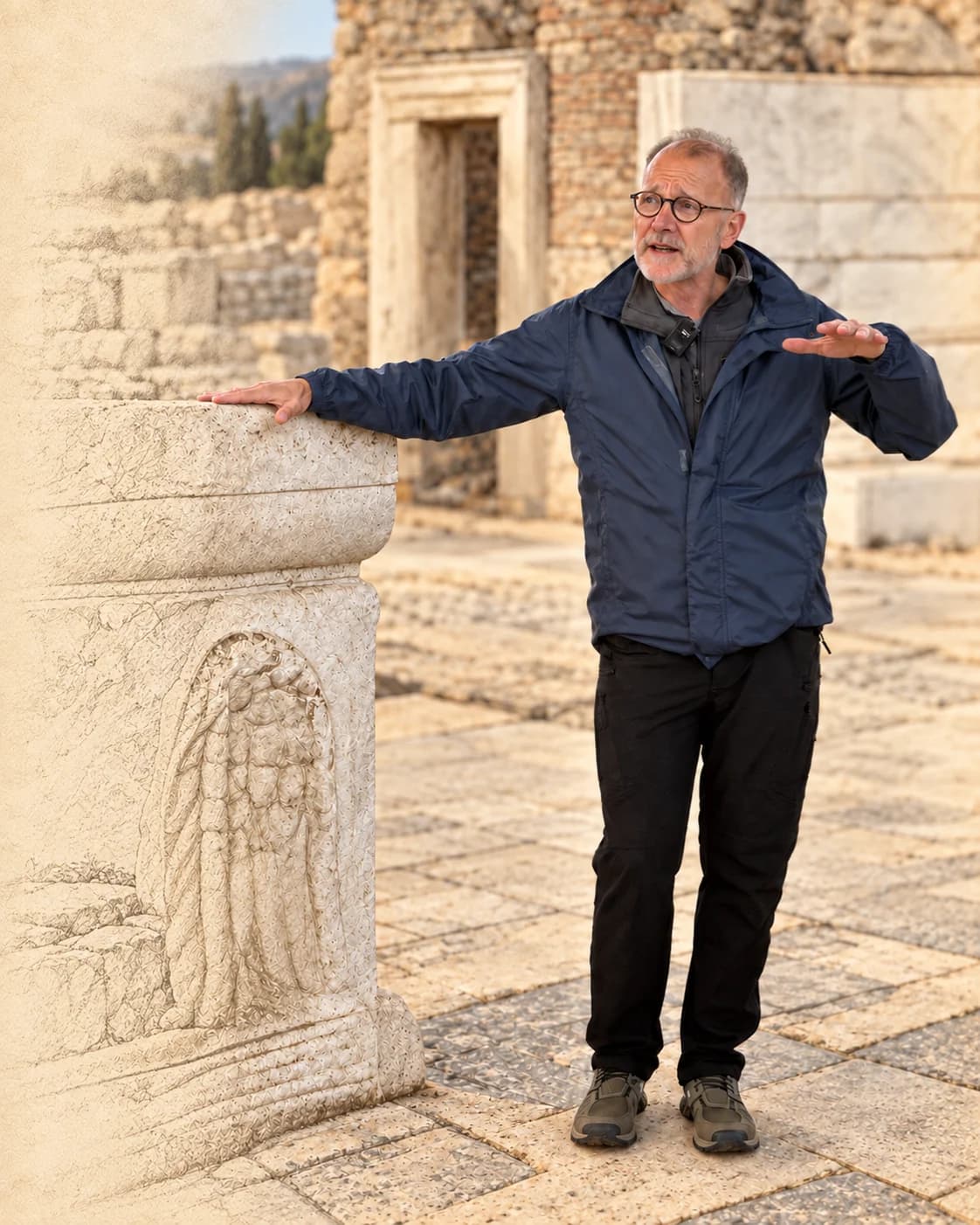

A definition that starts in the dirt
Missiological archaeology is the discipline of reading material culture — graffiti, inscriptions, temples, coins, spolia, mosaics — as evidence of God's movement among peoples, then using that reconstruction to test contemporary missions. The stones do not decorate a commentary. They fill the gap the literary record leaves, so a planter can see how the earliest witnesses inhabited religion, politics, and philosophy without imposing a form that had not yet been invented.
Mark Noll once suggested that missiologists are uniquely placed to work history's particularities and tensions. The same skill set belongs at an excavation site. Archaeology already deals in religion, economics, language, and symbol — the layers missiology probes. When those disciplines meet, the result is a task I have come to call archaeological exegesis: the missiological reading of a site until the past answers why it still matters.
In a very real sense, archaeology can "fill the gap left in the historical record" as well as the missiological one.
Gods, Emperors, Philosophers, and a New Movement, chapter 1.
Sixteen of the twenty-seven New Testament books tie directly to Asia Minor. Ignore the civic elite of Ephesos, the guilds of Thyatira, the synagogue-spolia of Sardis, or the lukewarm wine of Laodicea, and you will keep reading contemporary planting methods back into Acts. Missiological archaeology exists to stop that habit.
How the discipline works
The work begins with an object, not a slogan. A graffito in Smyrna's agora. An honorific inscription for a kourēs. A peacock mosaic laid over a former cult floor. A temple later used as a church. Each artifact is a sentence in a language of form. The missiologist's job is to reconstruct the sentence, translate it, weigh its significance for the churches of Revelation and Acts, and only then adjudicate what a contemporary movement may copy, refuse, or transfigure.
That last move is the point. Colonial "mission archaeology" often uncovered European buildings dropped onto indigenous soil and called the result Christianity. First-century Asia Minor tells a different story. Early ekklēsia had no identifiable architectural type. Space was adapted — in places of peace, in the houses of wealthy saints, later in repurposed temples — because the church was a people before it was a plan. First-century allegiance is not fourth-century membership. Confuse those centuries and you will export a basilica as if it were the gospel.
Paul already practiced a version of this reading. In the Lycus Valley he names Christ the eikōn of the invisible God (Col 1:15) against a landscape of statues believed to carry power, and he speaks of plērōma (Col 1:19) in a region schooled by Platonic completeness. He even uses geological instability as pastoral counsel: remain "stable and steadfast" where the ground itself shifts (Col 1:23). The text breathes the air of the place. Missiological archaeology simply refuses to treat that air as optional.
The same habit belongs in the Hall of Tyrannos at Ephesos, where daily reasoning with a city, not a borrowed sanctuary, launched a movement. Missiological exegesis of a site is of a piece with missiological exegesis of a people: dialogue and observation first, then reflection in a hermeneutical community, then a culturally meaningful confession of Jesus.
Characteristics you can actually use
Material culture is missiological evidence. Graffiti, inscriptions, and temples are not "background color." They disclose how people sought healing, honor, salvation, and meaning. When emperors are titled savior and benefactor, the Christian claim that Jesus is sōtēr and kyrios is not a clever slogan. It is a public juxtaposition in a world already using those words.
The method runs from stone to strategy. Inscription, reconstruction, translation, significance, contemporary adjudication. Skip the last two steps and you have a site lecture. Skip the first three and you have an untested method. I wrote Gods, Emperors, Philosophers, and a New Movement so each excavation would turn toward application: what this record requires of church planting now.
Jesus is presented as better, not as a local mascot. A. K. Amberg and I call this missiological parallelism: a cultural or religious form that mirrors a biblical image, clarifying what God is already doing in a culture and confronting the spiritual distortions inside the form. Emperors, physicians, philosophers, and gods supplied the vocabulary. The movement used that vocabulary to announce that Jesus is a better logos, a better healer, a better pantokratōr. The claims were ontological and practical. They were not redemptive analogies and they were not a license to baptize the cult.
Form carries theology. Architecture is not neutral. "Ecclesiology is not a footnote to theology; it is theology embodied." When a movement copies celebrity stages, consumer campuses, or foreign silhouettes, the building preaches before the sermon starts. Asia Minor shows both the gift and the danger of adapted space: spolia can confess Christ, and uncritical accommodation can become Montanist over-contextualization in a gateway city like Philadelphia.
The record is incomplete and still decisive. Only a fraction of Ephesos, Pergamon, and Laodicea has been unearthed; Colossae's dirt is only now being moved. Reflexivity threatens both historian and archaeologist. The missiologist still has five reasons to stay in the trench: contextual understanding, chronological perspective, cultural insight, corroboration of the literary record, and a path from interpretation to application. The stones we do have already expose anachronism.
Boundaries of the field
Tourist biblical archaeology can stop at wonder. Missiological archaeology cannot. Wonder without reflection leaves the church with photographs and the same imported sanctuary it arrived with.
The discipline also refuses to treat first-century adaptation as a new law. Private homes and adapted space were descriptive of a people without a building type; they are not a mandate to make "house church" the only New Testament model. I have been explicit: adaptive, not normative. The same caution applies to guilds, synagogues, and philosophical schools. They were places the gospel entered. They were not templates to photocopy.
Colonial mission archaeology is a warning, not a method. When the material record of later missions shows genetically European Christianity on indigenous ground, the lesson is how easily form catechizes the wrong story. First-century Asia Minor, by contrast, shows a movement comfortable in language, clothing, and civic custom while remaining a distinct hairesis — a school of thought that would not dissolve into the cults around it.
Finally, missiological archaeology is not a technique for counting sites or mapping generations. Those metrics belong to a different conversation. The stones argue that God had already been moving in culture — in Theophilos's elite world, in the agora's scratchings, in the hunger for a true physician — and that faithful witnesses joined what was already underway. Method is a servant of that recognition.
Why the definition matters now
Without this field, planters keep reading their favorite method into Acts 19 and calling the result biblical. With it, they inherit a diagnostic: does this form confess Jesus as better than the reigning cults of honor, therapy, nation, and technique, or does it baptize those cults?
The practical yield is cultural wisdom with a theocentric spine. Early missionaries identified how God bridged language, space, and worldview so that Christ could be seen with unveiled eyes. Contemporary workers in religiously plural cities face the same assignment. When I sat with Rajneesh — syncretism tolerated as "culture" while the gospel shrinks to a vice list — I heard the modern twin of Philadelphia's over-accommodation. The stones and the field stories interpret each other.
Walk the streets of Ephesos, Sardis, or Laodicea and you are walking our history. The God who moved in that material world continues to move. The manner of his self-revelation will not photocopy, yet the pattern holds: read the culture until you can say what God is doing, then say why Jesus is better, then inhabit space in a way that does not lie about that confession.
That is missiological archaeology. It is scholarship in the service of the glory of God among the nations — and a planter can carry the question out of the ruin: What does this stone forbid me to import?