


The Church Was Never Meant to Stand Still
For many Christians, the word church immediately evokes a place. We go to church, enter the church, sit in church, and leave church when the service ends. For others, church refers primarily to an institution with property, employees, programs, budgets, and a carefully managed weekly schedule. These things may serve the life of the church, but none of them adequately defines it. A building can house a church, an institution can support a church, and a weekly gathering can express the life of a church. Yet the church itself is a people called into a shared life under the lordship of Jesus Christ and caught up in the continuing movement of God.
This is the central conviction of what I call movemental ecclesiology. Movemental ecclesiology understands the ekklēsia as a Spirit-formed people gathered into the life and mission of the Triune God. It begins neither with the church’s organizational needs nor with its preferred forms. It begins with God, who speaks, acts, sends, reconciles, and moves toward creation in love. The church does not create this movement. It is invited to discern and participate in it.
The church was never meant to stand still because the God who calls the church is not inactive. Yet movement does not mean ceaseless busyness, constant innovation, or the rejection of every institution. The church gathers, waits, worships, learns, remembers, and rests. Its movement is not frantic activity but faithful participation in the dynamic mission of God.
Recovering the Ekklēsia as a People
The Greek word ekklēsia did not originally name a religious building. It referred to an assembly—a people gathered for a shared purpose. The earliest Christians adopted the word to describe communities whose lives had been reorganized around Jesus. They gathered in households, workshops, schools, and other available settings, but no particular setting constituted the church. The people were the ekklēsia.
This distinction matters because forms quietly shape theological imagination. When church becomes primarily a location, discipleship is easily reduced to attendance. When it becomes primarily a weekly event, worshipers can become an audience and ministry a performance delivered by religious professionals. When it becomes primarily an institution, preservation can displace participation. Decisions are then evaluated by whether they sustain the organization rather than whether they help a people embody Christ and join the mission of God.
The answer is not to abolish gatherings, leaders, structures, or institutions. Every community requires some form. The question is whether the form serves the identity and calling of the ekklēsia or gradually replaces them. Structures are faithful when they cultivate communion, formation, discernment, witness, and the participation of the whole body. They become problematic when keeping the structure alive becomes the church’s controlling purpose.
Movemental ecclesiology therefore changes the question. Instead of asking only, “How do we get people to come to church?” it asks, “How is God forming a people who embody the life of Christ where they live?” Instead of beginning with, “How do we preserve our programs?” it asks, “What is God doing among these people, in this place, at this moment, and how are we being called to participate?”
The Mission and Movement of God
In Ephesiology and Missiological Theology, I distinguish several related terms that help us locate the church within the activity of God. They are not separate missions or successive programs. They describe different dimensions of a single theological reality.
Missio Dei identifies whose mission it is: God’s. Mission does not begin with the church’s needs, vision statement, or strategic plan. It arises from the life of the Triune God. The Father sends the Son; the Father and Son send the Spirit; and the Spirit forms and empowers a people who bear witness to Christ. God does not acquire a mission because the world presents a problem. The self-giving love revealed in divine sending belongs to who God eternally is.
Motus Dei describes God’s movement toward peoples and cultures. If missio Dei identifies the source and ownership of mission, motus Dei emphasizes its direction and activity. God is already present and at work before a missionary arrives or a church launches a program. God moves toward people in revelation, conviction, healing, reconciliation, judgment, and grace. This does not imply that every religious intuition is salvific or that every culture is inherently redemptive. It affirms that no people or place exists beyond God’s presence and activity and that salvation remains centered in the historically particular Jesus Christ.
Missio ecclesiae names the church’s participation in God’s mission. Strictly speaking, the church does not possess an independent mission. God has a church through which he carries out his mission. The missio ecclesiae is therefore derivative and participatory. The church embodies the life of Christ, announces the gospel, makes disciples, practices reconciliation, cares for what has been broken, and bears visible witness to the reign of God. It does not ask God to bless a mission of its own making; it receives its calling within the mission that already belongs to him.
Motus ecclesiae describes the church moving toward peoples and cultures as a participant in the motus Dei. The church does not move toward people to introduce an absent God. It moves to discern, embody, and make explicit the work of the God who is already present and active among them. It bears explicit witness to Jesus Christ, who fulfills, clarifies, corrects, and sometimes confronts the truths, longings, practices, and distortions encountered within every culture.
The relationship can be stated simply: the mission belongs to God; God moves toward the world; the church is invited into that mission; and the church therefore moves toward others in faithful participation. The movement of the church follows the movement of God.
Ephesus: A Church Caught Up in Movement
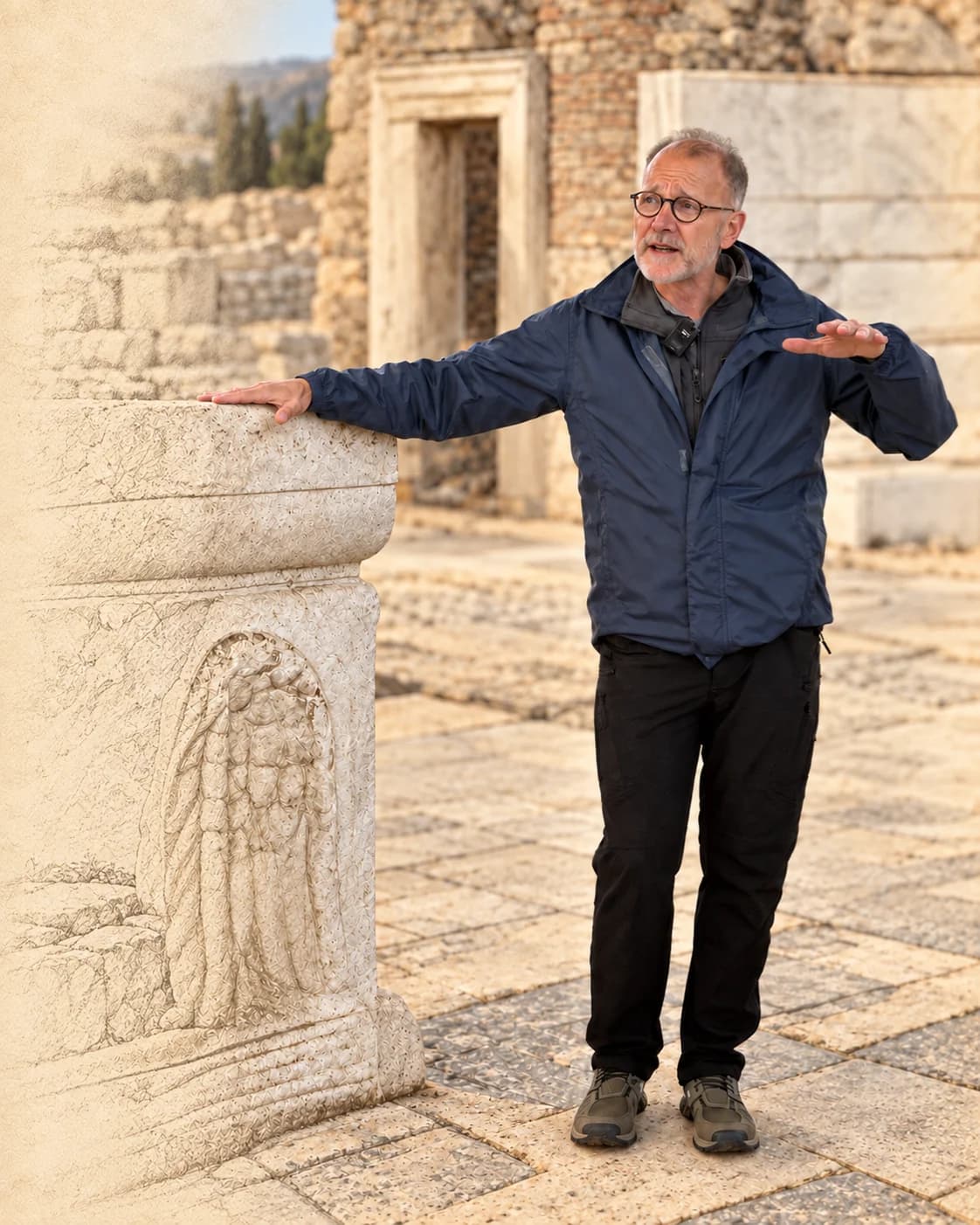
The Ephesian movement provides a concrete picture of this ecclesiology. During Paul’s ministry in Ephesus, the word of the Lord spread throughout Roman Asia (Acts 19:10, 20). This could not have occurred through Paul’s individual activity alone. The hall of Tyrannus served as a place of teaching and formation, but the movement did not remain inside the hall. Disciples, co-laborers, households, artisans, messengers, and locally rooted leaders carried the gospel through relational networks into the wider region.
The movement also affected more than private religious belief. As people reoriented their lives around Jesus, established patterns of spiritual practice changed. The economic interests surrounding the production of Artemis images were threatened. Religious transformation became economic disruption, and economic disruption became a civic confrontation in the theater. The gospel was not merely being discussed; it was reorganizing allegiance, identity, relationships, practices, and public life.
This is one reason Ephesiology studies a movement rather than merely a congregation. The ekklēsia in Ephesus cannot be reduced to one gathering, one leader, or one location. It was a relational ecosystem of communities and co-laborers sharing a Christ-centered identity and participating in the movement of God across cultural and geographical boundaries. The church gathered, but it did not remain enclosed. Formation became witness, and witness generated new communities capable of embodying Christ in their own contexts.
Yet Ephesus does not supply a method to be copied. Movemental ecclesiology is not a call to reproduce the hall of Tyrannus, a particular household arrangement, or an idealized first-century organizational structure. The early Christian movement adapted its forms to its settings. Ephesus, Colossae, Laodicea, and Hierapolis were connected by shared convictions and relationships, but their communities emerged within different social and cultural landscapes. Faithfulness did not require uniformity.
Gathered and Sent
Describing the church as movement does not diminish the importance of gathering. The ekklēsia is gathered by God before it is sent into the world. In worship, prayer, table fellowship, teaching, mutual care, and shared discernment, believers are formed into a people capable of participating faithfully. Without gathering, movement can become activism without communion, multiplication without maturity, and mission without theological coherence.
But gathering is not the destination. The church gathers in order to be formed and is formed in order to participate. Worship trains desire. Scripture reshapes imagination. Prayer cultivates attentiveness. Fellowship creates a shared life. The gifts of Christ equip the saints for diakonia. The gathered community becomes a sent community—not because everyone leaves for a distant place, but because every believer inhabits relationships, households, workplaces, neighborhoods, and cultural spaces in which the life of Christ can become visible.
The church therefore lives in a rhythm of gathering and sending, contemplation and participation, communion and movement. If either dimension is lost, ecclesiology becomes distorted. A church that only gathers risks becoming an audience. A church that only goes risks becoming an activist network. Movemental ecclesiology holds both together within the life of the Triune God.
From Institutional Maintenance to Faithful Participation
Institutional maintenance becomes the controlling posture when the church assumes that its inherited forms must survive. Energy is then directed toward preserving attendance, budgets, buildings, programs, and leadership systems. These concerns are not inherently wrong. The danger arises when they determine the church’s imagination and make participation in God’s movement secondary.
A missiological recalibration begins with a different question: not “What should our church do?” but “What is God doing?” That question requires curiosity, prayer, cultural attentiveness, theological reflection, and communal discernment. It may expose programs that no longer form disciples. It may reveal gifted people who have been treated as spectators. It may call the church beyond its property and into overlooked relationships. It may require new forms capable of embodying Christ among people who would never enter the inherited ones.
This recalibration is not innovation for novelty’s sake or disruption because institutions are unfashionable. It is the continual reorientation of the church to Jesus Christ. Five questions can help a community begin:
Where do we see evidence that God is already speaking and acting among the people around us?
Are our gatherings forming participants in the life of Christ or primarily attracting an audience?
Which structures serve discipleship and shared mission, and which now exist mainly to preserve themselves?
Whose gifts and relationships are being overlooked because ministry remains concentrated in professional roles?
What culturally meaningful forms might help the ekklēsia embody Christ faithfully in this place and time?
These questions do not offer a formula for generating a movement. God remains the author of movements. We pray, plant, water, teach, gather, and go, but God gives growth. Our responsibility is not to manufacture divine activity. It is to become a people capable of recognizing and joining it.
The church was never meant to stand still because it has been gathered into the life of the God who moves toward the world in love. Buildings may remain in place. Institutions may endure for generations. Weekly gatherings may continue to shape faithful communities. But the ekklēsia cannot be confined to any of them. It is a people under the lordship of Jesus, animated by the Spirit, and invited to participate in the reconciling movement of God.