


A definition aimed at a lost name
Cultural engagement is faithful presence in plural, post-Christian, and religiously diverse contexts. It means reading cultures — ancient and modern — so the gospel can engage without syncretism, and recovering evangelical identity rooted in missiology rather than in a culture-war posture or a purely Reformation pedigree. The working movement of the practice is engage, discern, witness.
The book's title is a missiological joke with a bite: when American evangelicals sneeze, the world catches a cold. Form travels. Political fever travels. A recovery of identity is therefore not an intramural branding exercise. It is an act of love toward churches who never sat through the fundamentalist-modernist debate and should not have to inherit it as the gospel.
Cultural fragmentation, pluralization, and globalization have made "evangelical" a contested word. Trumpgelicalism and evangelical deconstruction only made the contest louder. Western evangelicalism has tended to define itself from the sixteenth century. I am asking whether a first-century, missiological root would serve the global church — and the American one — better.
The weakness of the evangelical identity based upon the Reformation lies in its discontinuity with the rest of Christian history. … Simply rooting evangelicalism in the Reformation negates the fact that evangelicals share the same 2,000 year history with the rest of global Christianity.
When Evangelicals Sneeze, "Evangelical Identity Rooted in Missiology."
McGrath's six convictions — Scripture, the majesty of Christ, the Spirit's lordship, conversion, evangelism, community — still name gifts. Variations of emphasis, interpretation, and added convictions already fragment the family. Those variations need not become a culture war. They become a crisis when identity is no longer missiological. They do not, by themselves, keep American evangelicalism from searching for identity in political parties and social causes, the way Europe searches pre-Christian religions and Africa traditional ones. The parent theme is Cultural Engagement.
How engagement works
Engage. Early Christians in Asia Minor inhabited language, clothing, civic custom, guilds, and philosophical vocabulary. They were a distinct hairesis, not a sealed subculture. Missiological parallelism, as Amberg and I define it, is a device in which a cultural or religious form mirrors a biblical image, clarifying what God is doing in a culture and confronting the distortions inside the form. Jesus as logos, kyrios, sōtēr, pantokratōr did not compete as one more cult option. The claim was that he is better. That is public engagement, not a culture-war boycott and not a baptized Artemis.
Discern. Bediako's second-century map still helps: Tertullian and Tatian stress discontinuity with Greco-Roman culture; Justin and Clement stress continuity. Both moves can be faithful; both can become vice. Philadelphia's Montanist over-contextualization is the archaeological warning against shallow grounding. Rajneesh's delay of idol-renunciation as "culture" is the field warning against syncretism dressed as sensitivity. Discernment asks the pairing I keep returning to: What is God doing, and why is Jesus better?
Witness. Oden's paleo-orthodox instinct — recover the memory the martyrs and the first councils fought for — belongs here as boundary, not as nostalgia. Vincent of Lérins' canon (ubique, semper, ab omnibus) and the baptismal Name set edges. Witness inside those edges can be indigenous. McGrath notes that evangelicalism remains tied up in the West, which makes contextualization difficult. The flu the world caught from American evangelicalism is a form problem as much as a doctrine problem. Indigenous believers disappointed with Western expression are already in a kind of reformation. American evangelicals should learn rather than export the culture war as the gospel.
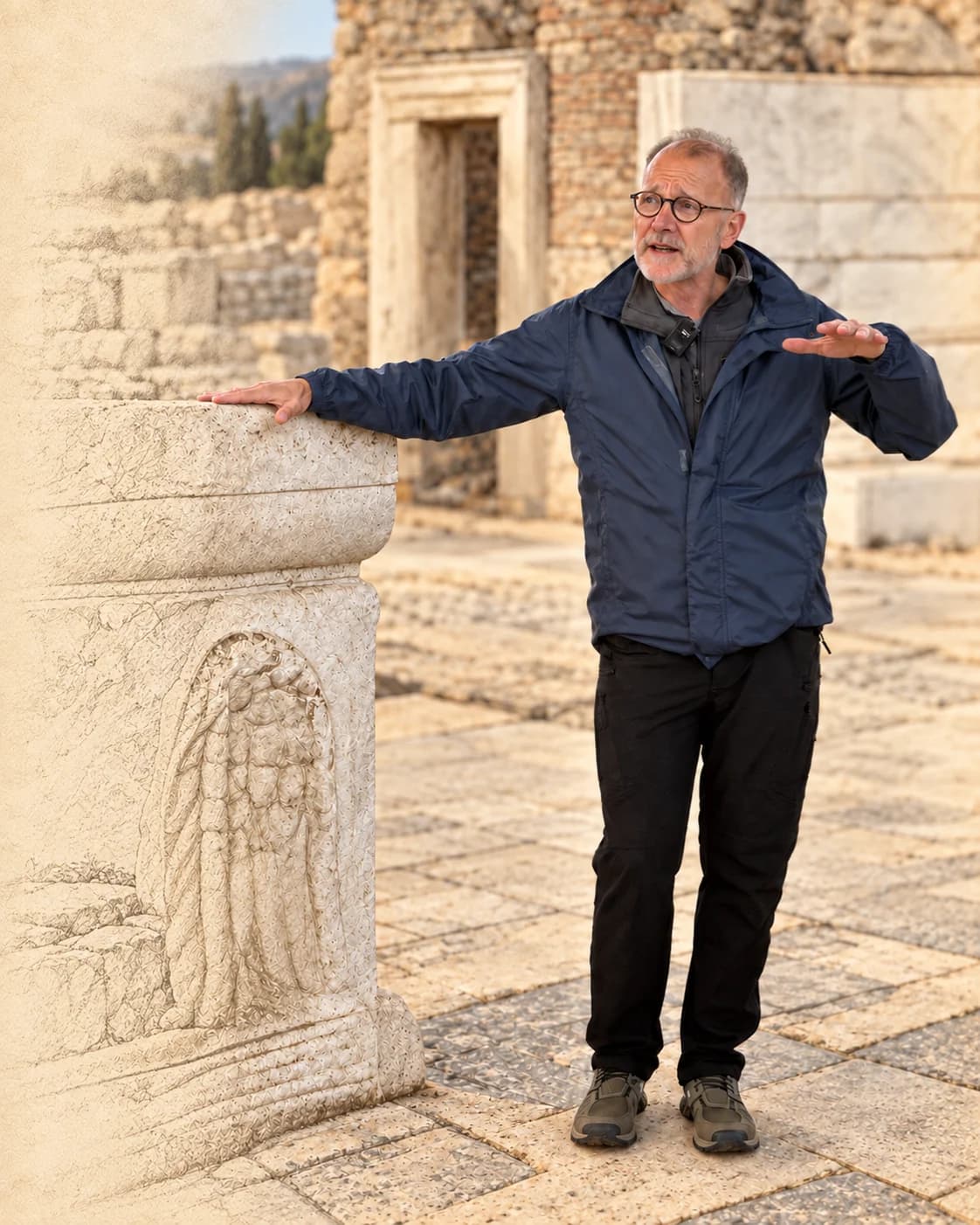
Justin saw the implanted Logos; Clement saw philosophy fulfilled. Gods, Emperors, Philosophers, and a New Movement watches the same pattern in stone: Christianity as missiological parallel to religion, politics, and philosophy. The gospel is analytic (truth-telling), catalytic (moving toward people), and cathartic (healing what is broken). Culture-war religion is usually only analytic, and even then it analyzes enemies more than neighbors.
Characteristics of the posture
Identity from mission. Evangelicalism derives its name from gospel ministry. When that root is replaced by a party, the sneeze becomes a virus others catch.
Historical depth without Reformation monopoly. The solas and the priesthood of believers were correctives in a Catholic European crisis. They are not the entire Christian past. Oden and Bediako push toward the first centuries and toward local self-understanding. I want those voices in the identity conversation.
Respect without agreement. Disciples in Ephesus were respectful of people and culture in evangelism (Acts 19:8, 37) because all people bear God's image. Respect is not syncretism.
Form as fidelity. Architecture, political branding, and worship style catechize. "Form reflects fidelity." A movement that mimics celebrity culture, nationalism, or therapeutic religion mutes the gospel it meant to speak.
Learning posture toward the global church. Europe still sends more missionaries than any continent, the United States more than any country, while most evangelicals live elsewhere. That mismatch makes American culture-war identity a missiological hazard. McGrath wanted evangelicals to relate the heritage of the past to the realities of the present. I agree — then I lengthen the past past 1517 and widen the present past Washington.
Engage–Discern–Witness is not a weekend workshop. Engage means the marina, the guild, the philosophy hall, the neighbor's table: presence before pronouncement. Discern means naming continuity (Justin, Clement, missiological parallelism) and discontinuity (Tertullian, Tatian, first-love refusal of syncretism) without using either as a club. Witness means a public Jesus who is better than emperor, physician, party, and brand — the same juxtaposition Asia Minor already knew how to hear.
What engagement refuses
It refuses withdrawal: a sealed evangelical enclave that treats pluralism only as threat. The first-century movement did not have that luxury and did not need it. It refuses syncretism: blending local ecstatic or political cults until Jesus is a mascot. It refuses culture-war evangelicalism that confuses the gospel with a four-year virus of partisan identity.
It also refuses the idea that "evangelical" can be conserved only by repeating 1517. Diversity already fragments the movement into tens of thousands of denominations. McGrath feared loss of identity through diversity; I fear a false unity purchased by Western form. Privatization of faith (Weber's long shadow) made religion personal and public life political. Missiological engagement puts faith back in the square without making the square into a church.
A Faithful Witness and even my earlier ethnography of contemporary Druidry train the same muscle: read a non-Christian world without panic. Panic produces either crusade or hiding. Neither is witness.
Why the definition matters
Without this posture, American evangelicals will keep offering the world a culturally specific flu and calling it orthodoxy. With it, a planter in a plural city can inhabit the public square the way Asia Minor's churches inhabited theirs: intelligible, distinct, theocentric. The sneeze stops being destiny once that identity is missiological again.
The glory of God among the nations will not be served by winning a culture war or by disappearing from culture. It will be served by a people who know their name from the gospel, who can say why Jesus is better than the current cults, and who love their neighbors enough to learn the language those neighbors already speak. That is evangelical identity with a missiological spine — and it can be practiced this week in a plural city without waiting for a better century.