

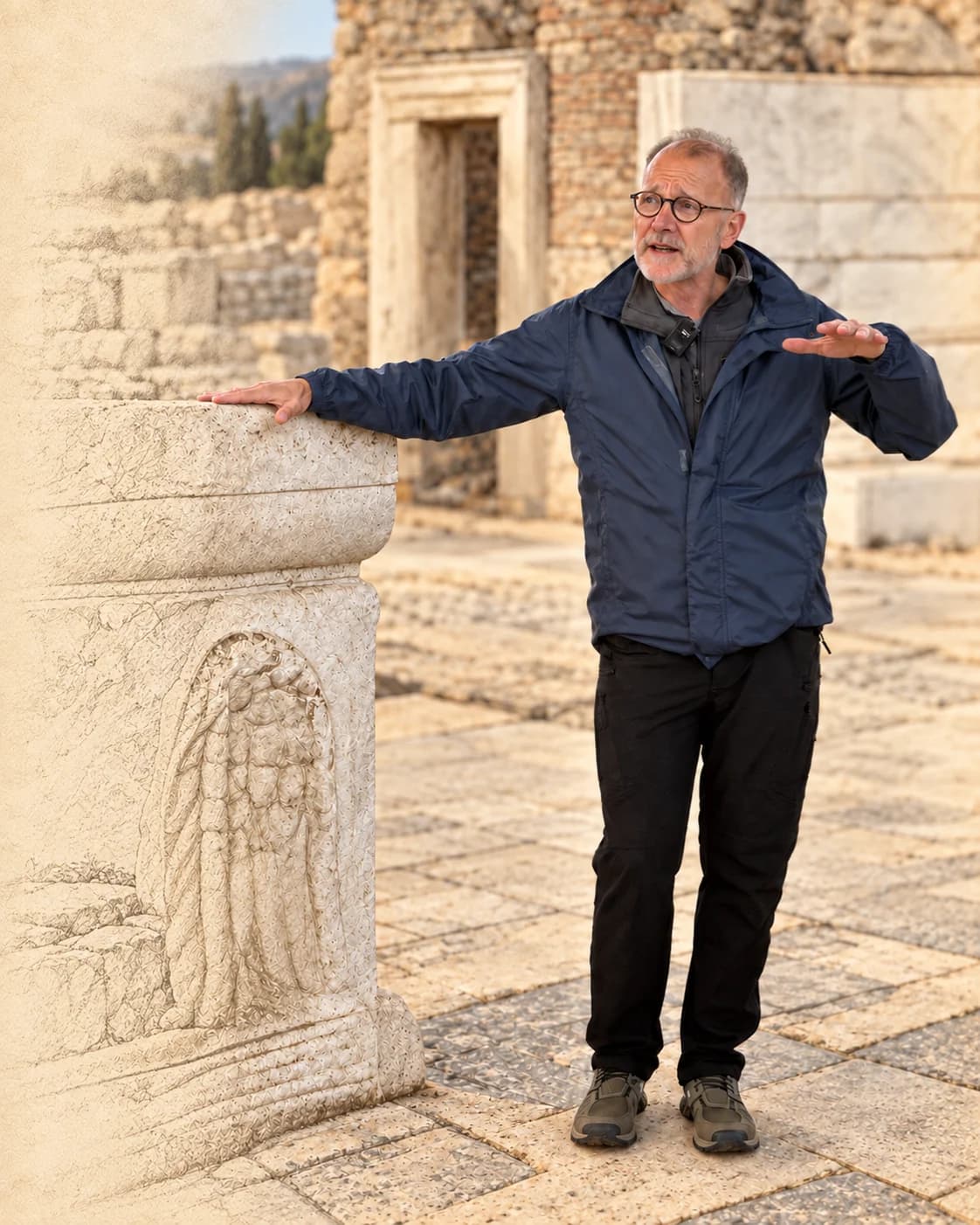

An AI-Powered Missiological Strategy Assistant
What if we became more curious about a place before deciding what we should do there?
That question has shaped much of my work in missiology over the past three decades. Whether entering a neighborhood, engaging a people group, planting a church, or developing a ministry strategy, we often feel pressure to move quickly toward action. We identify needs, establish goals, choose methods, and develop plans. But missions begins before strategy. It begins with learning to see.
That conviction is behind Ephesio, an AI-powered missiological strategy assistant I have been developing to help church planters, missionaries, ministry leaders, and teams undertake careful cultural research and translate what they discover into thoughtful missiological strategy. Ephesio is not intended to tell people what to do. It is designed to help them ask better questions.
Why Ephesio?
Years ago, I began developing a process for cultural study and strategy development that required practitioners to move beyond demographic information toward a much thicker understanding of a community. Who are these people? What stories have formed them? What do they value? How do families and relationships work? Where is authority located? What religious beliefs and practices shape everyday life? What does the community fear, celebrate, remember, and hope for? How do people understand themselves? And eventually: What might participation in the missio Dei look like here?
Answering those questions requires more than downloading demographic statistics or asking an AI system to “develop a church-planting strategy for my city.” It requires cultural exegesis. Ephesio provides a guided process for doing precisely that.
AI Is the Assistant, Not the Missiologist
This distinction is important. Ephesio uses artificial intelligence extensively, but it does not treat AI as a substitute for the practitioner, the local community, prayerful discernment, or the work of the Holy Spirit. AI can search, organize, compare, synthesize, and identify patterns across enormous amounts of information. Those capabilities make it a remarkable research assistant.
But AI does not live in your neighborhood. It does not sit with the people you are seeking to understand. It does not share meals with families, walk through markets, listen to stories, observe religious practices, or develop relationships with community leaders. And it should not be entrusted with discerning, by itself, what faithful participation in the mission of God looks like in a particular place. That responsibility remains with people.
For that reason, Ephesio intentionally combines AI-assisted research with local knowledge, human observation, theological reflection, and communal discernment. The goal is not automated missions strategy. The goal is better-informed missiological discernment.
A Guided Cultural Study
Ephesio walks a person or team through a ten-step cultural research and strategy-development process. Before that research begins, however, there is Step 00: Preparing for the Journey. Users are encouraged to gather resources they already possess: demographic studies, historical information, ethnographies, maps, interviews, field notes, organizational reports, local research, photographs, and observations from people who actually live in the community.
More importantly, Step 00 establishes a posture for the study. Ephesio invites participants into a rhythm that has become increasingly important in my understanding of missiological spirituality: Curiosity → Discovery → Reflection → Wonder → Participation.
Curiosity asks questions. Discovery pursues what we do not yet understand. Reflection considers what our discoveries might mean, both individually and in community. Wonder recognizes that we are encountering something larger than a collection of cultural data. We are learning to recognize God, people, culture, history, and the movement of God with greater attentiveness. Participation asks how we might faithfully join what God is doing.
This means Ephesio is not simply a research tool. The process itself is intended to cultivate a missiological posture.
Beginning with Place and People
The first step seems deceptively simple: Identify the culture, people group, or specific community you want to study and state the purpose of the study. That establishes the boundaries for everything that follows.
From there, Ephesio helps investigate multiple dimensions of the community. Rather than treating culture as a collection of interesting customs, the process looks for the deeper patterns through which people construct meaning, relationships, identity, belonging, authority, and religious life.
At every stage, users can add their own observations and local knowledge. That matters because there will always be a difference between what can be learned about a community and what can be learned within one. Ephesio is designed to make those two forms of knowledge interact.
From Cultural Exegesis to Missiological Reflection
Research alone is not enough. Eventually we have to ask what our discoveries mean. Here Ephesio draws upon the missiological frameworks I have developed in Ephesiology and my broader research and writing. Cultural findings are brought into conversation with Scripture, theology, ecclesiology, movement dynamics, and the experience of the early Jesus movement.
One especially important part of the process is comparison with the New Testament and the archaeological record of the first three centuries. Why archaeology? Because archaeology gives us access to something remarkably important: evidence of Christians negotiating the relationship between allegiance to Jesus and the cultures in which they actually lived.
Inscriptions, houses, meeting spaces, symbols, mosaics, papyri, graffiti, burial practices, and other material remains allow us to observe traces of Christian life that survived outside literary texts. The early followers of Jesus were not implementing a universal ministry template. They were learning how to embody allegiance to Jesus in Ephesus, Corinth, Rome, Edessa, North Africa, and dozens of other cultural environments. Their experience gives us another conversation partner as we consider our own contexts.
From Strategy to Participation
Only after this process of investigation and reflection does Ephesio begin moving toward strategy. That sequence is intentional. Too much strategic planning begins with the question, What should we do? Ephesio tries to delay that question long enough for another one to emerge: Given what we are discovering about these people, this place, the gospel, and the movement of God, how might we faithfully participate?
That is a different kind of strategic question. The resulting strategy is therefore not meant to be an AI-generated prescription. Ephesio helps users identify possibilities, tensions, opportunities, relational pathways, potential barriers, and next steps that a local team can evaluate together. The final decisions belong to the people who will actually participate in the work.
What Ephesio Produces
As the user progresses through the study, Ephesio builds a cumulative research document. Each step includes both the detailed findings and a narrative synthesis explaining what those findings may mean for understanding the community. Rather than leaving users with disconnected pieces of information, the process progressively develops a coherent portrait of the context.
At the completion of the process, Ephesio generates a downloadable report—typically 25–40 pages—containing an executive summary, the research from each stage, narrative summaries, missiological reflection, and the resulting strategic considerations.
The report is valuable, but I increasingly think the process of producing it may be even more valuable. A team that spends time researching, questioning assumptions, adding local observations, discussing discoveries, praying, reflecting, and discerning together has already begun changing how it sees its community. That may be one of Ephesio’s most important contributions.
Why the Name Ephesio?
Ephesus has occupied an important place in my research for years. It was one of the great cities of the Roman world: religiously plural, economically connected, culturally complex, and deeply embedded within networks extending throughout Asia Minor and the Mediterranean. It also became an important center of the early Jesus movement.
Acts tells us that during Paul’s ministry in Ephesus, “all the residents of Asia heard the word of the Lord” (Acts 19:10). That statement describes something far larger than the activity of one missionary. It points toward a relational ecosystem through which the gospel moved from people to people and place to place.
Ephesus therefore provides an appropriate image for what this project is trying to recover: careful attention to people, place, relationships, culture, gospel, and movement. Hence the name Ephesio.
Technology in Service of Missiology
I am convinced that artificial intelligence will significantly affect how we conduct research, educate leaders, and develop ministry strategy. The question is not simply whether Christians will use AI. The more important question is how we will use it.
We can use AI to generate faster answers, or we can use it to help us become better investigators. We can ask it to produce strategies, or we can use it to expose us to information that challenges our assumptions and helps communities discern strategy for themselves. We can allow technology to accelerate our tendency toward quick solutions, or we can design technology that encourages curiosity, discovery, reflection, wonder, and ultimately faithful participation.
Ephesio is my experiment in the latter.
It brings together cultural research, missiology, theology, archaeology, movement studies, and artificial intelligence within a guided process designed around a simple conviction: Before we decide what to do in a place, we should learn how to see it.
And perhaps, as we learn to see more carefully, we will also become more attentive to the ways God is already at work there.
Learn more about Ephesio here.